Commanders and Command in the Roman Republic and Early Empire (Studies in the History of Greece and Rome) by Drogula Fred K
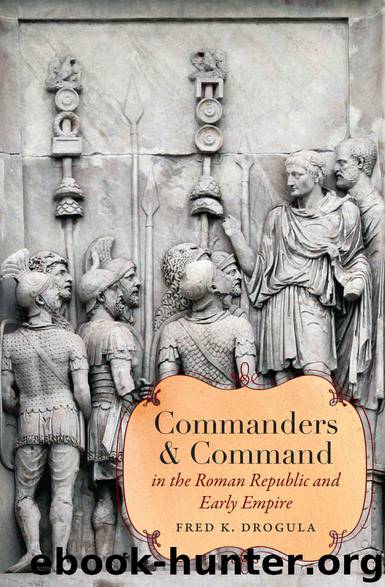
Author:Drogula, Fred K. [Drogula, Fred K.]
Language: eng
Format: azw3
Publisher: The University of North Carolina Press
Published: 2015-04-12T16:00:00+00:00
Privati cum imperio and Experiments with Rank
One final but important experimentation with Rome’s methods of provincial command during this period involved the complete separation of imperium from magisterial office. In a handful of instances during the Second Punic War, the Roman state decided to invest one of their private citizens (a privatus) with imperium and auspicium militiae and to assign him a provincia, which effectively and legally made that privatus a military commander, even if he had not yet held a magistracy entitled to possess imperium and auspicium militiae. This was similar to the battlefield commission of a lieutenant to act pro praetore, but these privati cum imperio were complete commanders because they possessed a provincia as well as independent imperium and auspicium.97 Still, the fact that privati cum imperio were not permitted to hold triumphs for their victories indicates that they were not seen as entirely legitimate commanders in the eyes of the Romans, probably because they had not held a magistracy.98 During the many crises of the Second Punic War, this method of quickly creating an extra military commander was a useful tool that enabled the Roman people to select any man—whether or not he had ever been elected to office—and make him the commander of any provincia they wished. The Roman people used the legislative authority of their assemblies to authorize the conferral of imperium and a provincia on a man of their choice, thereby rendering him a fully legitimate and independent provincial commander. In the early republic, the Romans had normally achieved this purpose by having one of the consuls name a dictator, but because dictators were not permitted to leave Italy, the office became less useful as more and more of Rome’s battles were fought overseas.99 Furthermore, the choice of man to become dictator had generally been at the sole discretion of the consul who named him, but privati cum imperio were selected by the popular assemblies, which would have been much more attractive to the Roman citizens during dangerous days of the Second Punic War. Like the dictator and the promagistrate, the privatus cum imperio was another Roman experiment to produce an extra commander in times of emergency.
The first recorded privatus cum imperio was created in 215 BC when the Romans, stunned by their incredible losses at Trebia, Trasimene, and Cannae, wanted a thoroughly capable and experienced man to take command when the consul L. Postumius Albinus was killed in battle. They elected M. Claudius Marcellus (cos. 222 BC) as suffect consul, but he was subsequently forced to step down when the augurs detected flaws in his election.100 Determined to have their choice of commander, the Roman people ordered that Marcellus was to be invested with imperium and auspicium militiae despite his abdication from office and was to take command of a consular army against Hannibal.101 Some modern scholars have questioned the constitutional mechanics of this event: Jashemski wondered whether the special grant occurred at all, while Develin and Stewart suggest that, since Marcellus
Download
This site does not store any files on its server. We only index and link to content provided by other sites. Please contact the content providers to delete copyright contents if any and email us, we'll remove relevant links or contents immediately.
The Vikings: Conquering England, France, and Ireland by Wernick Robert(84607)
Ali Pasha, Lion of Ioannina by Eugenia Russell & Eugenia Russell(40386)
The Conquerors (The Winning of America Series Book 3) by Eckert Allan W(39188)
The Vikings: Discoverers of a New World by Wernick Robert(37052)
Cecilia; Or, Memoirs of an Heiress — Volume 1 by Fanny Burney(32726)
Cecilia; Or, Memoirs of an Heiress — Volume 2 by Fanny Burney(32090)
Cecilia; Or, Memoirs of an Heiress — Volume 3 by Fanny Burney(32068)
Empire of the Sikhs by Patwant Singh(23209)
The Secret History by Donna Tartt(19479)
Hans Sturm: A Soldier's Odyssey on the Eastern Front by Gordon Williamson(18729)
Cat's cradle by Kurt Vonnegut(15566)
Pimp by Iceberg Slim(14805)
Sapiens: A Brief History of Humankind by Yuval Noah Harari(14559)
Norse Mythology by Gaiman Neil(13578)
Talking to Strangers by Malcolm Gladwell(13561)
Leonardo da Vinci by Walter Isaacson(13533)
4 3 2 1: A Novel by Paul Auster(12628)
Underground: A Human History of the Worlds Beneath Our Feet by Will Hunt(12238)
The Radium Girls by Kate Moore(12195)
